You're Running Out of Grip and You Don't Even Know It: The Real Cost of Ignoring Your Tires
I want to tell you about a very specific type of car guy. He's got a built motor, a tune that makes real numbers, coilovers dialed to the millimeter, and a set of tires he picked because they were the right size and fit his budget. He'll talk your ear off about his boost curve. Ask him about tire compound and he'll shrug and say "they're a good brand."
This guy is everywhere. And statistically, he's leaving more performance on the table through his rubber choice than through any other single decision in his build.
Tire selection is the most under-discussed, most consistently neglected performance variable in the enthusiast community. Not because people don't know tires matter — everyone knows tires matter — but because the connection between a specific tire choice and real-world performance is harder to see than a dyno graph or a lowered stance. That invisibility is costing people real grip, real handling, and in some cases, real safety.
The Four Contact Patches That Run the Show
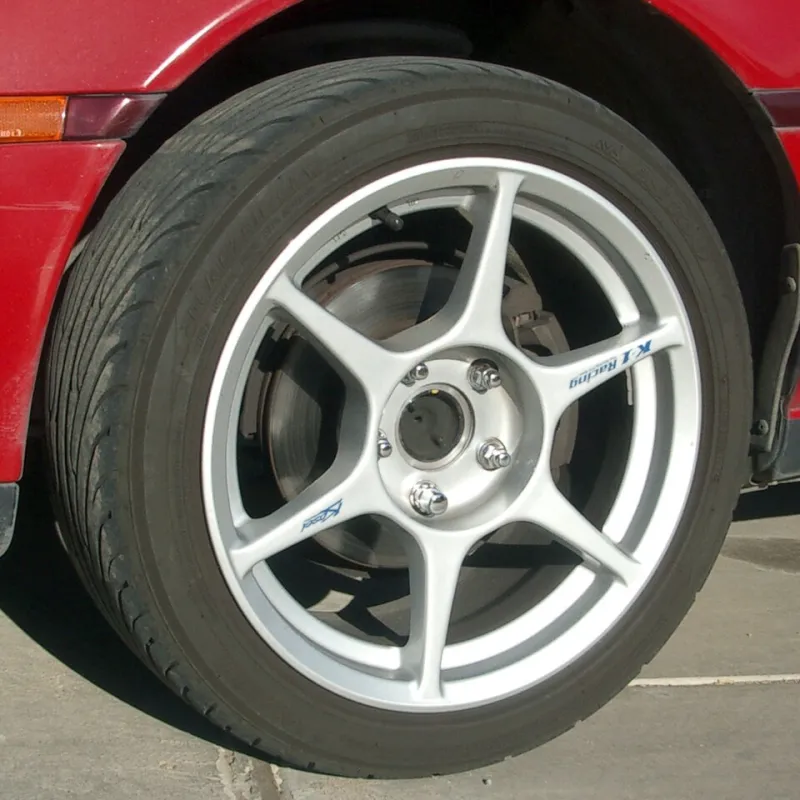
Every horsepower your engine makes, every degree of correction your suspension geometry provides, every pound of braking force your calipers generate — all of it ultimately has to pass through four contact patches roughly the size of your hand. That's it. That's the interface between your entire build and the road.
When you think about it that way, it becomes kind of absurd that tire choice is treated as an afterthought. Yet here we are.
The reason this happens is partly psychological and partly financial. Tires are a consumable. They wear out. Spending $1,200 on a set of Michelin Pilot Sport 4S tires that'll last 25,000 miles feels worse than spending $1,200 on a cold air intake and a tune that'll outlast the car. But that logic breaks down the second you actually drive both setups back to back.
Compound Is Everything — And It's Not Just About Stickiness
Tire compound gets talked about in broad strokes — summer tires, all-season tires, track compounds — but the nuance inside each category is where real decisions happen.
A high-performance summer tire like the Continental ExtremeContact Sport or the Bridgestone Potenza Sport uses a silica-rich compound that stays pliable across a wide temperature range, builds heat quickly under load, and maintains grip as it wears. A budget performance tire uses a harder compound that's cheaper to produce, takes longer to come up to temperature, and loses grip more dramatically as the tread depth decreases.
The difference on a modified car is significant. If you've got a front-wheel-drive hot hatch making 250 wheel horsepower through a tune and a downpipe, hard compound tires are going to spin under hard acceleration in ways that feel like a traction control problem. It might not be your TC calibration at all — it's your rubber.
For rear-wheel-drive builds with meaningful power, the gap widens further. A 400-horsepower muscle car on budget rubber is genuinely dangerous in a way that a 400-horsepower car on proper performance compound isn't. The physics don't care about your budget.
Sidewall Stiffness and the Lowered Car Problem
Here's where modified cars create a specific wrinkle that stock-car tire advice doesn't address: lowered suspension changes what you need from a sidewall.
When you drop a car on coilovers or lowering springs, you're typically running lower ride height and often more aggressive camber. That combination puts more lateral load on the outer sidewall during cornering. A tire with a soft, compliant sidewall — totally fine on a stock vehicle — will flex excessively under those conditions, introducing handling unpredictability and eating up the precise geometry you paid for with your suspension upgrade.
This is why tire width, aspect ratio, and sidewall construction all need to be considered together, not independently. A 245/40 tire has a stiffer sidewall than a 245/45 on the same wheel — the lower aspect ratio means less sidewall to flex. For a car running aggressive alignment specs and a stiff suspension setup, that matters. You're not just buying grip; you're buying a structural component of your handling system.
Running mismatched sidewall stiffness front to rear — which happens more often than you'd think when people mix tire brands or models — creates handling balance issues that no alignment adjustment can fully correct. The car will push or rotate unpredictably at the limit, which is a problem whether you're tracking the car or just pushing it hard on a canyon road.
Load Rating: The Spec Everyone Skips
Load rating is boring. It's a number on the sidewall that most people ignore unless they're buying truck tires. On a modified performance car, ignoring it is a mistake.
If you've added power, upgraded to heavier brakes, or changed your wheel and tire package, your load requirements may have shifted. A tire running at or near its load limit runs hotter, wears faster, and is more prone to catastrophic failure under sustained high-speed or high-load conditions. On a stock sedan, this is rarely an issue. On a built car that sees track days or sustained high-speed driving, it absolutely can be.
Always verify that your chosen tire's load index covers your vehicle's actual corner weight, not just the stock spec. This is especially relevant if you've added ballast, upgraded to heavier rotors and calipers, or are running a full fuel and passenger load.
Real-World Tire Mistakes That Went Sideways
Let's talk about some actual scenarios that happen regularly in the enthusiast community.
The Track Day Surprise: A WRX owner with a Stage 2 tune and upgraded suspension shows up to his first HPDE event on all-season tires. He's confused why he can't carry corner speed and why his car feels loose compared to slower, stock cars on summer compounds. The answer is compound temperature and grip — his tires were never designed to work at track operating temperatures, and they were telling him so by going greasy under sustained load.
The Street Build That Spun Out: A Camaro SS with a supercharger kit and 550 wheel horsepower was running budget 275-wide rear tires to save money. On a damp on-ramp, the driver gave it throttle mid-corner and found out exactly what happens when compound grip and sidewall control are insufficient for the power level. The car required bodywork. The driver was fine, but shaken.
The Handling Mystery: A tuned Golf R with quality coilovers and alignment couldn't figure out why the car understeered aggressively in fast corners. After months of alignment adjustments, someone finally noticed the front tires were a touring all-season spec while the rears were summer performance compound. The front-rear grip mismatch was pushing the handling balance toward understeer by design.
What Good Tires Actually Cost — And What They're Worth
A quality set of 18-inch summer performance tires in a common size will run you $800–$1,400 depending on brand and fitment. That sounds like a lot until you compare it to the cost of a minor accident, a set of bent wheels from a handling failure, or the performance gains you're currently not getting from your $3,000 suspension setup because your tires can't communicate what the suspension is doing.
Tires are the last link in every chain. Treat them that way.
The Upgrade That Changes Everything Else
Here's the honest truth: a properly selected set of tires will make your modified car feel more modified than almost any other single upgrade you can bolt on. The suspension you already have will work better. The power you already have will go down more efficiently. The brakes you already upgraded will stop you shorter.
Tires don't show up in photos. They don't make noise at idle. Nobody's going to walk around your car at a show and compliment your compound choice. But get in that car and drive it hard, and you'll feel every dollar you spent — or every dollar you didn't.